UN General Assembly: Jaishankar Calls for Peace, Warns India Will Defend Itself Against Terrorism
- International
- (Asia/Kolkata)
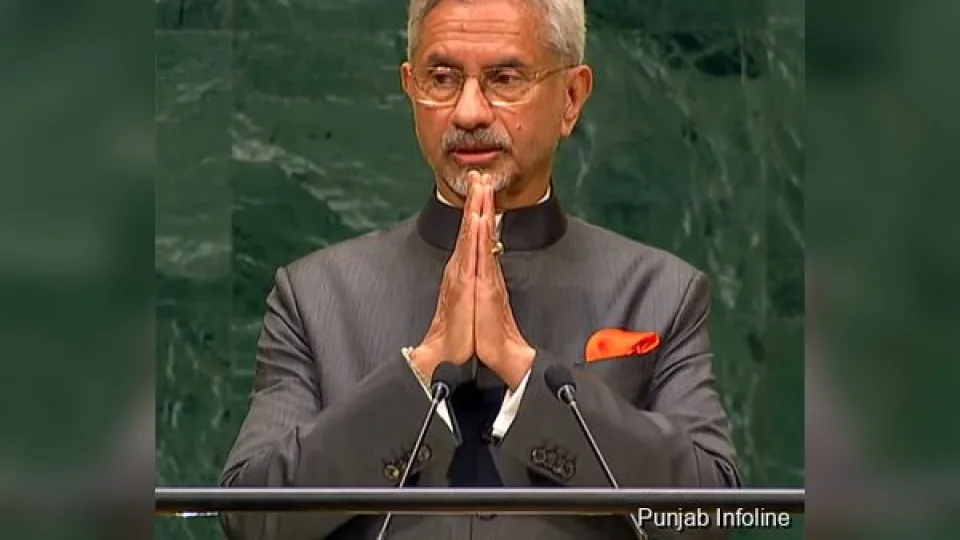
External Affairs Minister S. Jaishankar strongly advocated peace during his address to the United Nations General Assembly, while warning that India would exercise its right to defend itself against terrorism. He also said poorer countries should not have to bear the consequences of wars and decisions in which they have little role.
His address covered a wide range of issues, including ongoing conflicts in the Gulf region and Ukraine, food and energy security, development, artificial intelligence and reforms in global institutions. A central theme of his remarks was that peace depends not only on ending wars but also on stability and equitable access to resources.
Warning Against Terrorism
Some of Jaishankar’s strongest remarks were directed at a country he described as a “serial practitioner of terrorism”, without naming it in the speech. He alleged that the country had presented facts inaccurately before the General Assembly a day earlier and had sought to normalise terrorism and claim immunity from its consequences.
Jaishankar said, “India will exercise its right to defend itself against terrorism.” He did not name the country in that warning or specify what action India could take. He also stressed that cross-border terrorism cannot be treated as conducive to normal relations.
Call for De-escalation in the Gulf
Jaishankar said conflicts were slowing the pace of development while countries far from conflict zones were also being forced to bear their consequences. He told the General Assembly that those most affected by such developments are often the least heard.
Calling for restraint and de-escalation in the Gulf region, Jaishankar said attacks targeting ships and seafarers on international waterways were unacceptable. India, he said, wants the safety of civilians to be ensured and the movement of energy and trade to continue without disruption.
He also noted that Indian seafarers were among those killed in attacks across waters extending from the Gulf and Red Sea to the Black Sea.
‘4F Crisis’ Facing Developing Countries
For developing countries, Jaishankar described an overlapping “4F crisis” involving food, fuel, fertilizer and finance. Climate conditions, shortages of fertilizer and disruptions to the movement of grain have added to the pressures. He argued that limited market access and non-market practices were also making industrialisation more difficult for the Global South.
Focus on Artificial Intelligence
Jaishankar made a similar argument on artificial intelligence, saying every country should be able to develop AI models and use them according to its own priorities. He said India intends to make AI a component of its partnership with the Global South while remaining alert to the technology’s potential to amplify bias.
Call for a More Inclusive Global Order
Jaishankar concluded by focusing on who shapes the rules of a changing world. He said the post-1945 order was giving way to new realities and called for broader consultations and more transparent decision-making, arguing that a large part of humanity can no longer be left out.
The General Debate provides UN member states with an annual platform to outline their priorities. Jaishankar used India’s address to connect the country’s security concerns with a broader argument for a more inclusive international order supporting peace and development.