Sarbat Khalsa Jathebandi Writes to MHA, Objects to Compulsory Singing of ‘Vande Mataram’
- National
- (Asia/Kolkata)
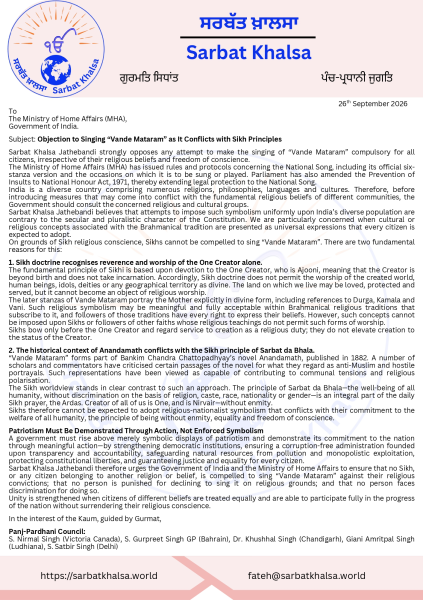
Sarbat Khalsa Jathebandi has written to the Ministry of Home Affairs (MHA), Government of India, raising an objection to any move to make the singing of Vande Mataram compulsory for citizens irrespective of their religious beliefs and freedom of conscience.
In its letter, the organisation referred to the rules and protocols concerning the National Song and the legal protection extended to it through the Prevention of Insults to National Honour Act, 1971. The organisation stated that India’s religious, philosophical, linguistic and cultural diversity should be taken into account before introducing measures that may conflict with the fundamental beliefs of different communities.
Objection Based on Sikh Religious Conscience
Sarbat Khalsa Jathebandi stated that, according to its understanding of Sikh doctrine, Sikhs recognise and worship the One Creator alone. The organisation said the Creator is Ajooni, meaning beyond birth and incarnation, and argued that Sikh doctrine does not permit the worship of the created world, human beings, idols, deities or geographical territory as divine.
The letter specifically refers to the later stanzas of Vande Mataram, which, according to the organisation, portray the Mother in divine forms including Durga, Kamala and Vani. Sarbat Khalsa Jathebandi said such symbolism may be meaningful within the religious traditions that accept it, but argued that it should not be imposed on Sikhs or followers of other faiths whose religious teachings do not permit such forms of worship.
The organisation further stated that Sikhs bow only before the One Creator and regard service to creation as a religious duty, rather than elevating creation to the status of the Creator.
Reference to Anandamath and the Principle of Sarbat da Bhala
In its second major objection, Sarbat Khalsa Jathebandi referred to the historical context of Vande Mataram and its association with Bankim Chandra Chattopadhyay’s novel Anandamath, published in 1882.
The organisation cited criticism of certain passages of the novel that it said have been viewed by scholars and commentators as containing anti-Muslim or hostile portrayals. The letter argues that such representations conflict with the Sikh principle of Sarbat da Bhala, which it describes as the well-being of all humanity without discrimination on the basis of religion, caste, race, nationality or gender.
The letter further refers to the Sikh concept of the Creator as Nirvair, or without enmity, and states that Sikhs should not be expected to adopt religious-nationalist symbolism that, in the organisation’s view, conflicts with equality, freedom of conscience and the welfare of all humanity.
Historical discussion of Anandamath has included differing interpretations. The Indian Express has reported that scholars have debated the novel’s portrayal of Muslims and the historical context in which it was written.
‘Patriotism Must Be Demonstrated Through Action’
Sarbat Khalsa Jathebandi also stated in the letter that patriotism should be demonstrated through meaningful action rather than enforced symbolism. It called for strengthening democratic institutions, ensuring transparency and accountability in administration, protecting natural resources, safeguarding constitutional liberties, and ensuring justice and equality for citizens.
The organisation urged the Government of India and the Ministry of Home Affairs to ensure that no Sikh or any citizen belonging to another religion or belief is compelled to sing Vande Mataram against their religious convictions.
It further urged that no person should be punished for declining to sing the song on religious grounds or face discrimination for doing so.
According to the letter, the organisation believes that unity is strengthened when citizens of different beliefs are treated equally and can participate fully in the progress of the nation without surrendering their religious conscience.
Letter Signed by Panj-Pardhani Council
The letter has been issued in the name of the Panj-Pardhani Council of Sarbat Khalsa Jathebandi. The signatories listed are S. Nirmal Singh (Victoria, Canada), S. Gurpreet Singh GP (Bahrain), Dr. Khushhal Singh (Chandigarh), Giani Amritpal Singh (Ludhiana) and S. Satbir Singh (Delhi).
The letter comes amid the ongoing national discussion over the legal status and official treatment of Vande Mataram. The Prevention of Insults to National Honour (Amendment) Act, 2026 extended legal protection under Section 3 of the 1971 Act to the National Song, covering intentional prevention of its singing or disturbance of an assembly engaged in singing it.